Three-level tool gate
Global → per-agent → per-feature. The agent registry carries per-agent model overrides; every tool call passes the gate before it runs.
Self-hosted · Local-first · Invite-only
Ezza is one self-hosted workspace for chat, a coding agent, kanban, and workflow automation — running against your own models, on your own hardware.
One shell · Four modes
A shared shell with a mode switcher — one session model, one settings system, from the browser down to the glasses. These previews mirror the real app UI.
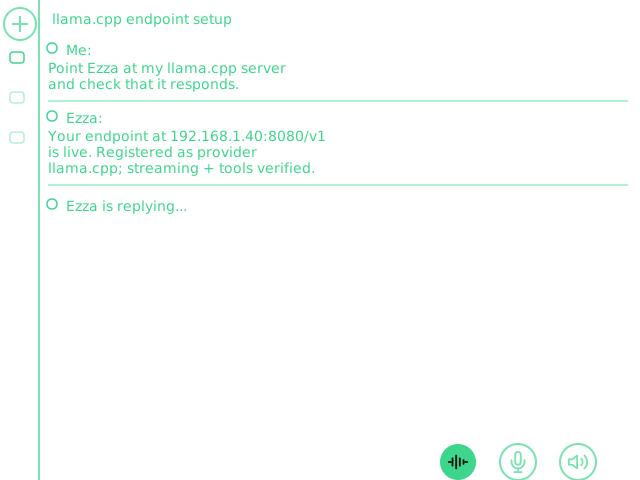
Ezzav2.4Your endpoint at 192.168.1.40:8080/v1 is live. I registered it as provider “llama.cpp” and verified streaming plus tool calls. Want me to save a memory for the endpoint?
Ezzav2.4Ezzav2.4Ezzav2.4Voice · Live Chat · Even G2
Live Chat is a hands-free voice loop with on-device VAD and barge-in (Android & desktop). On the Even G2, hold the temple and the same session answers on your lenses.
Speak naturally — I'll listen, respond out loud, and you can interrupt me anytime.
Push-to-talk speech-to-text, low-latency streaming TTS read-aloud, and a four-phase voice calibration. Barge-in stops the assistant the moment you start speaking. The status circle above is the app's real Live Chat panel.
HOLD TEMPLE TO TALK · LC3 ↑ · STT → SAME SESSION
LC3 audio over BLE → STT → the same chat sessions → streamed reply on the glasses display. The phone proxies everything. These are the real glasses app screens — switch between them above. Launcher apps are reorderable and toggleable from phone settings.
Feature parity · One codebase
One Kotlin Compose Multiplatform codebase — all business logic shared across web, desktop, and Android, plus a voice-first client for the Even G2.
Kotlin 2.4.20CMP 1.12.1| Capability | WebwasmJs · Ezza server | DesktopJVM · fat JAR + installer | Androidnative · minSdk 24 | Even G2BLE · LC3 · in Android app |
|---|---|---|---|---|
| Chat & shared sessions | ✓ | ✓ | ✓ | voice-first |
| Code agent | ✓ | ✓ | ✓ | launcher |
| Kanban | ✓ | ✓ | ✓ | launcher |
| Automate | ✓ | ✓ | ✓ | — |
| Voice · TTS / STT | ✓ | ✓ | ✓ | hold-to-talk |
| Live Chat · VAD loop | — | ✓ | ✓ | — |
| Settings & per-user sync | ✓ | ✓ | ✓ | via phone |
Kotlin/wasmJs in the browser, served by the dedicated Ezza server. Production access over HTTPS via Cloudflare Zero Trust.
JVM app shipped as a fat JAR and Windows installer. Identical UI and features.
Native app from the same shared code. Runtime permissions and keyboard-aware layout.
Voice-first BLE client inside the Android app. The phone proxies everything; sessions stay shared.
Local-first · Self-hosted
Privacy and ownership are the headline, not an afterthought. Ezza runs against your own server and your own models — nothing else is required.
A lightweight Ktor server keeps per-user state in file-backed JSON — no database. Clients hold their own state and sync across devices.
Any OpenAI-compatible endpoint — llama.cpp, for example — configured centrally under Providers & Models. Voice runs on audio.cpp-compatible TTS/STT endpoints.
Google sign-in on every platform. Admin and member roles, one-time invite links, per-user data isolation, and profile pictures.
Honest UI is a contract: every surface shows real data or an explicit empty/error state — never dummy placeholders. Limitations are documented as v1 boundaries, not hidden.
Control · Depth
Global → per-agent → per-feature. The agent registry carries per-agent model overrides; every tool call passes the gate before it runs.
Persistent facts the assistant can create, update, and remove from chat. You review and edit them in settings — nothing is hidden.
Back up the entire server state and restore it elsewhere. File-backed JSON keeps backups plain, portable, and yours.
Providers & Models, Integrations, MCP, Users, Voice, Agents, Tools, Chat, Code, Wearable Integration, Memories, Backup / Restore, Labs — the same panels on every platform.
Deploy the Ktor sync layer, point it at your models, and invite your people with one-time links.